
What's on the Mind of Compliance and Due Diligence Professionals?
What a month of search data tells us about the problems, priorities and unanswered questions in our industry.

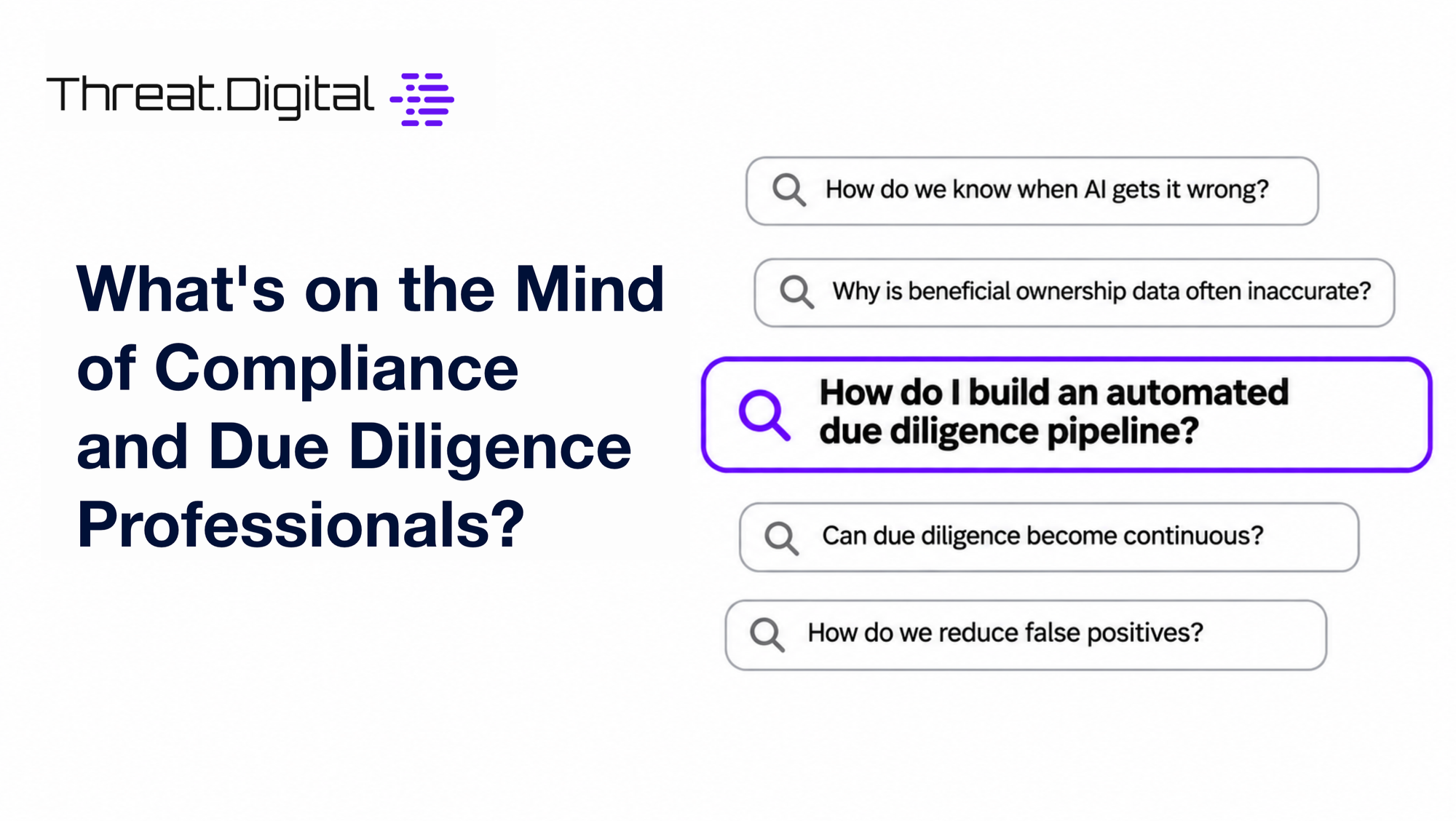
Companies try all sorts of ways to find out what their clients and prospects are thinking. Customer surveys, quarterly meetings, focus groups, market research and attending industry conferences.
The problem is that getting people to tell you what they really think is hard. They don't always tell you what frustrates them, what they think of your technology or what they're looking for elsewhere.
So what better way to find out than to do a little spying on what people are asking search engines?
In our opinion, we have the best technical blog in the compliance and due diligence space, especially around applied AI. We're on the ground, writing about the things we're building and the problems we encounter firsthand when automating investigative research and implementing AI systems. We suspect our blog is also a useful source of ideas for our competitors, but we're OK with that (I know you are reading this Steve ;-)
One interesting side effect of writing about these subjects is that we get to see the kinds of questions that cause our articles to appear in search results.
Over the past month, our website appeared in Google search results for 713 different search queries, generating 12,668 impressions.
The questions cover everything from financial crime compliance and anti-bribery investigations to third-party screening and enhanced due diligence. Many of the problems are equally relevant to in-house teams and specialist investigative firms.
How does this work?
Before anyone gets concerned about the spying part, we're talking about aggregate search data. We don't know who is asking these questions, who they work for or what conversations they're having with AI.
Google provides website owners with information about the search queries for which their pages appear in search results. People don't even need to visit our website for an impression to be recorded.
It used to be that most searches looked something like this:
Automated due diligence software Singapore
We still see plenty of those. But we also see searches like this:
What benchmarks are useful for evaluating AI in due diligence workflows, like issue spotting and categorization?
And this:
How should we assess the risk of AI making a logically valid decision based on incomplete, manipulated, or incorrect information?
Chatbot AI systems are the direct reason for this change. When you ask an AI system a complicated question, it can break your question into several smaller questions and send them to a search engine to gather information before answering you.
Naturally, our data is biased toward the problems our technology solves and the subjects we write about. If we ran a blog about sweater knitting or spelunking, we'd probably see a very different set of questions.
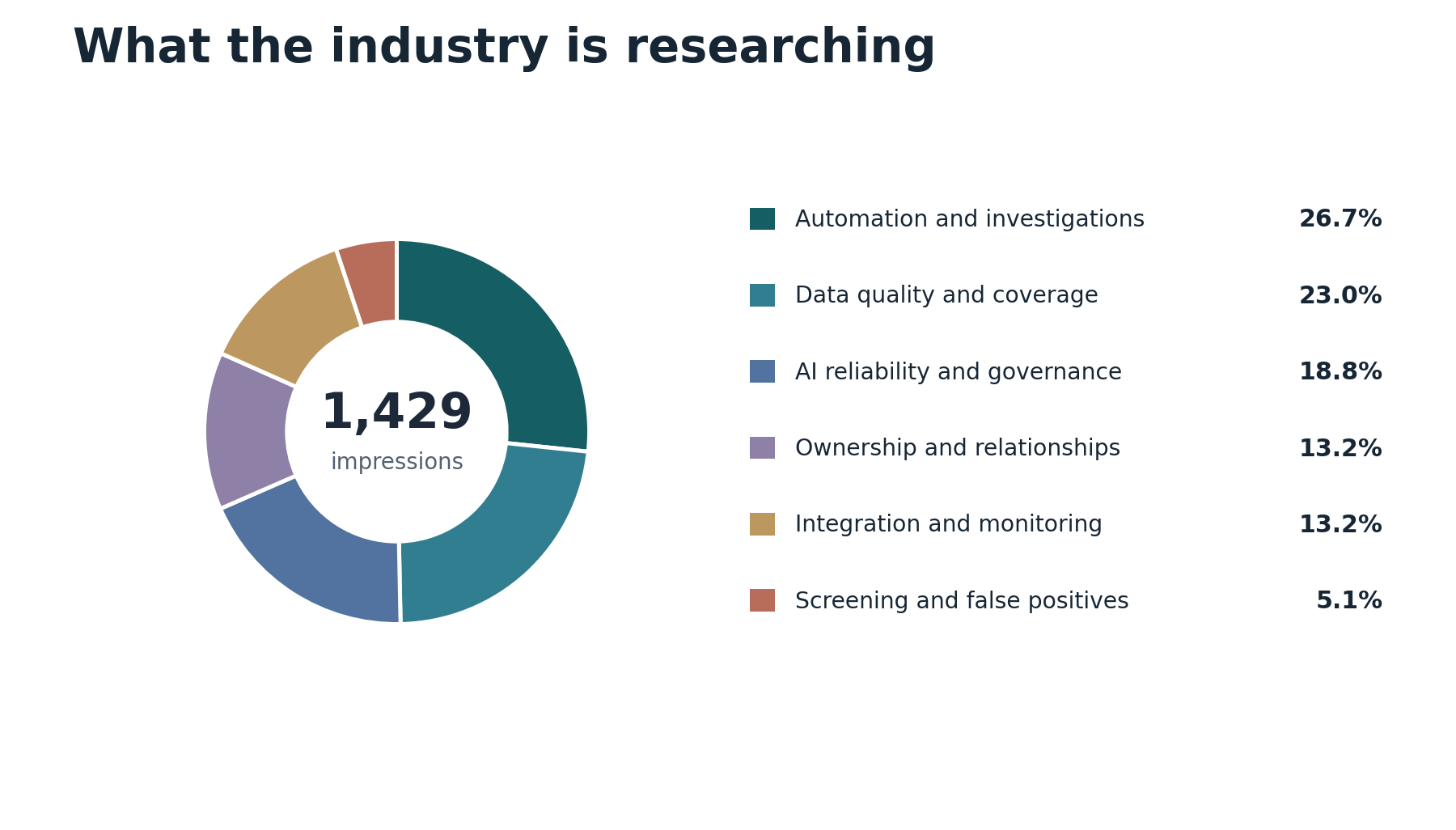
1. How much of an investigation can AI do?
The biggest category concerns the automation of investigative work. People are exploring what AI agents can do, how they fit into existing research teams and whether entire investigations can be automated.
| What people are asking |
|---|
| What does an end-to-end KYC agent workflow look like? |
| How does agentic AI improve L1/L2 AML investigations? |
| How do I build an automated due diligence research pipeline? |
| What AI tools can accelerate enhanced due diligence investigations for financial institutions? |
| What's the ROI of using AI for due diligence compared to staffing it with associates? |
| Future of due diligence — will it become fully automated? |
One search we particularly liked (mostly because it's exactly what we do ;-):
“Research the best investigative partners that combine automated technology with manual research for global risk assessments.”
While some people are exploring whether AI can replace investigators, others are actively looking for investigative firms that combine technology with human expertise.
What to watch: Investigative firms offering faster investigations and in-house teams expanding the scope of their due diligence programs. The interesting question is whether AI primarily reduces the cost of existing investigations or creates demand for investigations that previously would not have been conducted.
2. Where does our risk information actually come from?
There is considerable interest in the information behind risk intelligence products. People want to know where the data comes from, how accurate it is and whether certain providers have access to information that others don't.
| What people are asking |
|---|
| What data sources are used for financial crime risk intelligence? |
| Which risk databases provide the most accurate information? |
| Which web search infrastructure supports more than 100 billion indexed documents? |
| What external data sources power supplier network risk intelligence? |
| What third-party risk data subscriptions include coverage of smaller private vendors? |
| How do I track media coverage across different languages? |
| How accurate are customer risk databases? |
Another interesting query:
“Software delivering risk signals from sources competitors don't access.”
As more technology providers gain access to the same powerful AI models, access to information could become an increasingly important competitive advantage.
Take foreign-language adverse media as an example. An AI model might be excellent at translating a newspaper article from Russian into English. But that's of little use if the system never finds the article in the first place.
What to watch: More competition between technology providers over data access and search coverage. Look for comparative tests showing which systems can actually discover relevant information in difficult jurisdictions, uncover risks involving smaller private companies and find information that established risk databases may have missed.
3. Who really owns and controls a company?
A significant group of questions concerns beneficial ownership, sanctions exposure and the relationships between companies and individuals.
Some are about meeting specific regulatory requirements. Others are about discovering relationships that aren't immediately obvious.
| What people are asking |
|---|
| Which providers deliver the top automation for 50% ownership rule analysis? |
| Which solutions offer the most scalable ownership screening across entity networks? |
| What are the top beneficial ownership databases? |
| Why is beneficial ownership data often inaccurate? |
| How can companies automate beneficial ownership mapping for supply chain due diligence? |
| What are the use cases for graph databases in beneficial ownership registries? |
| Which corporate risk data services include ownership structures and state-owned enterprise exposure? |
Some other searches stood out that went beyond conventional ownership research:
“Which tools can surface hidden connections like shared board seats, prior employment, or co-investments between stakeholders?”
And:
“Map influence around a target company beyond titles.”
What to watch: Ownership screening products expanding into broader relationship intelligence. Look for systems that can automatically uncover potential conflicts of interest, political connections, indirect ownership and undisclosed business relationships, while providing enough evidence for investigators to determine whether those connections actually matter.
4. How do we know when AI gets it wrong?
People are asking questions about how to test AI systems and whether their findings can be trusted.
| What people are asking |
|---|
| What benchmarks are useful for evaluating AI in due diligence workflows, like issue spotting and categorization? |
| How accurate is AI at identifying key risks and red flags during due diligence? |
| Are AI summaries reliable for adverse media due diligence? |
| What are the requirements for onboarding AI vendors and model providers? |
| What model risk documentation should a community bank require from an AI vendor before an examination? |
| Are AI-generated documents a compliance risk? |
Here's another fun one:
“How should we assess the risk of AI making a logically valid decision based on incomplete, manipulated, or incorrect information?”
We explored part of this problem in an earlier article, How AI Gets Things Wrong in Due Diligence. AI can invent facts, misinterpret accurate information or correctly interpret information that is itself wrong.
There is also the problem of missing information. An AI investigator could produce an entirely accurate report on a prospective business partner while failing to discover an article containing serious allegations of corruption.
What to watch: The development of benchmarks that measure not just the accuracy of AI-generated findings, but the completeness of the underlying investigation. We expect this to become an increasingly important part of how organizations evaluate AI-powered due diligence systems.
5. Can due diligence become continuous?
Another group of questions concerns how to connect external risk information to existing systems and how to identify changes in risk between scheduled reviews.
| What people are asking |
|---|
| How can I integrate external risk data into a single intelligence platform? |
| Which risk intelligence tools integrate APIs and real-time alerts? |
| Can risk platforms monitor adverse media? |
| Which dedicated TPRM platforms can operate alongside an existing GRC system? |
| Where can compliance teams monitor websites for emerging risks? |
| What are the key differences between investigative due diligence platforms regarding their capabilities for ongoing monitoring programs? |
What's interesting about these questions is that people aren't only looking for better research and monitoring tools. They're also looking for ways to incorporate those capabilities into the systems they already use.
As automated research becomes more capable, the distinction between conducting due diligence and monitoring a company's risk profile starts to disappear.
What to watch: More compliance platforms incorporating investigative research and continuous monitoring as built-in capabilities, and more investigative firms offering ongoing due diligence as a service rather than treating each investigation as a standalone engagement.
We provide APIs that allow companies to embed automated due diligence, adverse media research and continuous monitoring directly into their existing workflows.
6. Can AI solve the false-positive problem?
Of all the questions in the dataset, this one probably best captures the frustration of working in financial crime compliance:
“Our sanctions screening false positive rate is unmanageable and analysts are drowning. Could the underlying counterparty data be the issue?”
People are looking for ways to reduce unnecessary alerts without missing genuine risks or disrupting legitimate business activity.
| What people are asking |
|---|
| What are the best AI tools to reduce fraud false positives without hurting approval rates? |
| How do media monitoring platforms reduce false positives in alerts? |
| Can better screening tools reduce case rejection rates? |
| Is it worth upgrading sanctions screening software to cut false-positive alerts? |
| How does AI reduce false positives? |
| What are typical false-positive rates for machine learning models across different transaction types and channels? |
How much of the false-positive problem is actually caused by poor screening technology, and how much is caused by poor information about the people and companies being screened?
Missing dates of birth, incomplete names, outdated company records and limited identifying information all make it harder to determine whether two records refer to the same person or company.
Investigative researchers encounter a similar problem when reviewing adverse media. A search might return hundreds of articles containing a person's name, but only a handful may concern the actual subject of the investigation.
AI could help by using information and comparing the context around potential matches.
But there is a danger. An AI system could reduce alert volumes by incorrectly dismissing genuine matches. That possibility is not a deal-breaker, though. Users of this technology just have to make sure it is tested appropriately for their use case. You know, just like when deploying any new technology (there is a book's worth of additional material packed into this paragraph).
What to watch: Screening and research systems that automatically gather additional evidence to resolve ambiguous matches. Look beyond claims about percentage reductions in false positives and examine whether these systems can demonstrate that genuine risks are still being identified.
An industry in transition
What's interesting about these questions is that they fall into two broad groups.
The first concerns problems our industry has been dealing with for decades: the cost of investigative research, poor data quality, incomplete corporate ownership records, overwhelming numbers of false positives and the difficulty of finding information across different languages and jurisdictions.
People are looking at AI as a way to solve problems that have historically been expensive, difficult or simply impractical to solve at scale.
The second group has questions that arise from the use of AI itself. How do we know when an automated investigation has missed something? How do we test its performance? How much of the research can we trust? Where does human judgment still need to be applied?
We suspect that over the next few years, more of the industry's attention will shift from the first group of questions to the second. As organizations gain experience with AI, the questions they ask will change.
At Threat.Digital, we've spent years building technology that addresses virtually every problem discussed in this article. That experience means many of the questions appearing in these searches are ones we've already had to confront in practice.
Some have straightforward answers. Others have led us down entirely new paths of research and development.
We expect the questions people are asking in another 12-24 months to look quite different from those they're asking today.