
The State of Global Beneficial Ownership Data
Global company databases cover hundreds of millions of entities, but natural-person UBO data remains much less complete.

Corporate data has never been more available. Government registries publish company names, registration numbers, directors, filing histories and legal status. Commercial databases aggregate hundreds of millions of company records across jurisdictions.
But for most compliance and research workflows, users do not stop at confirming that a company exists. They want to know who owns it, who controls it, how the ownership chain is structured, and ultimately which natural person sits at the end of that chain. That is where global company data becomes much less complete.
The gap between company coverage and beneficial ownership coverage is large, and it is often obscured by headline database counts. A provider may have hundreds of millions of company records and billions of ownership relationships while still being unable to identify the ultimate beneficial owner of many currently registered companies.
How many companies are there?
There is no single global registry of companies, so the denominator has to be estimated from national registries, government statistics and large-scale commercial datasets.
Based on those sources, a reasonable working estimate is that there are roughly 200 million to 250 million currently registered companies worldwide. This includes companies that legally exist today, whether or not they are economically active. It excludes sole proprietors and other non-incorporated business forms.
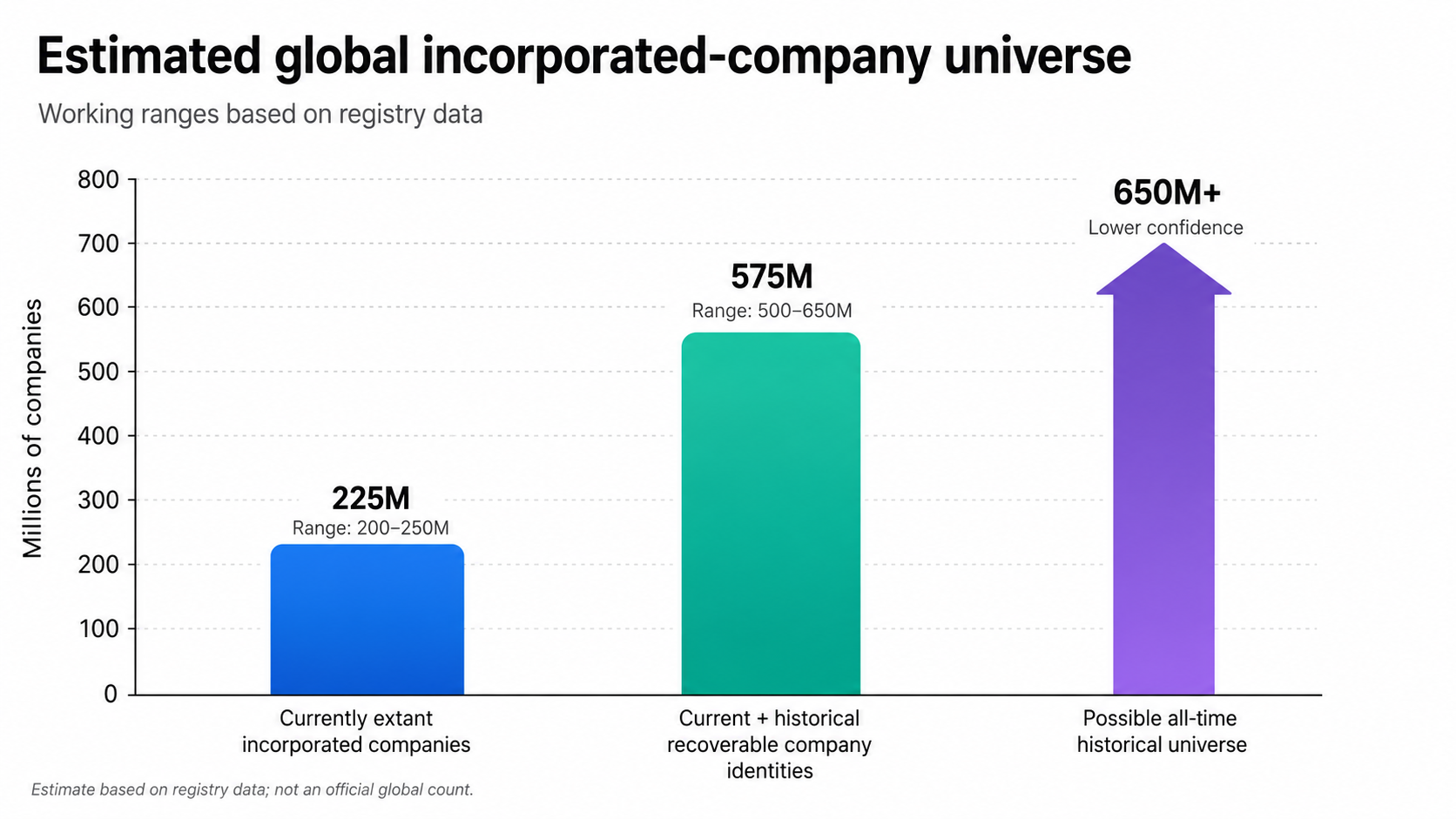
The historical universe is much larger. Companies are incorporated, dissolved, struck off, merged and liquidated every day. Many registries retain those historical identities for years or decades, and those entities still matter for due diligence, litigation, sanctions research, ownership analysis and corporate history.
Once current and historically recoverable entities are included, the practical global universe is likely on the order of 500 million to 650 million company identities. This should be treated as an approximate range rather than a precise count, because no authoritative global historical registry exists and historical retention practices and entity definitions vary by country.
The true all-time number of companies ever incorporated is probably higher still. Some older records were never digitized, some have been archived offline, and some have been destroyed under local retention rules. A cumulative historical universe above 650 million is plausible, but it cannot be measured reliably.
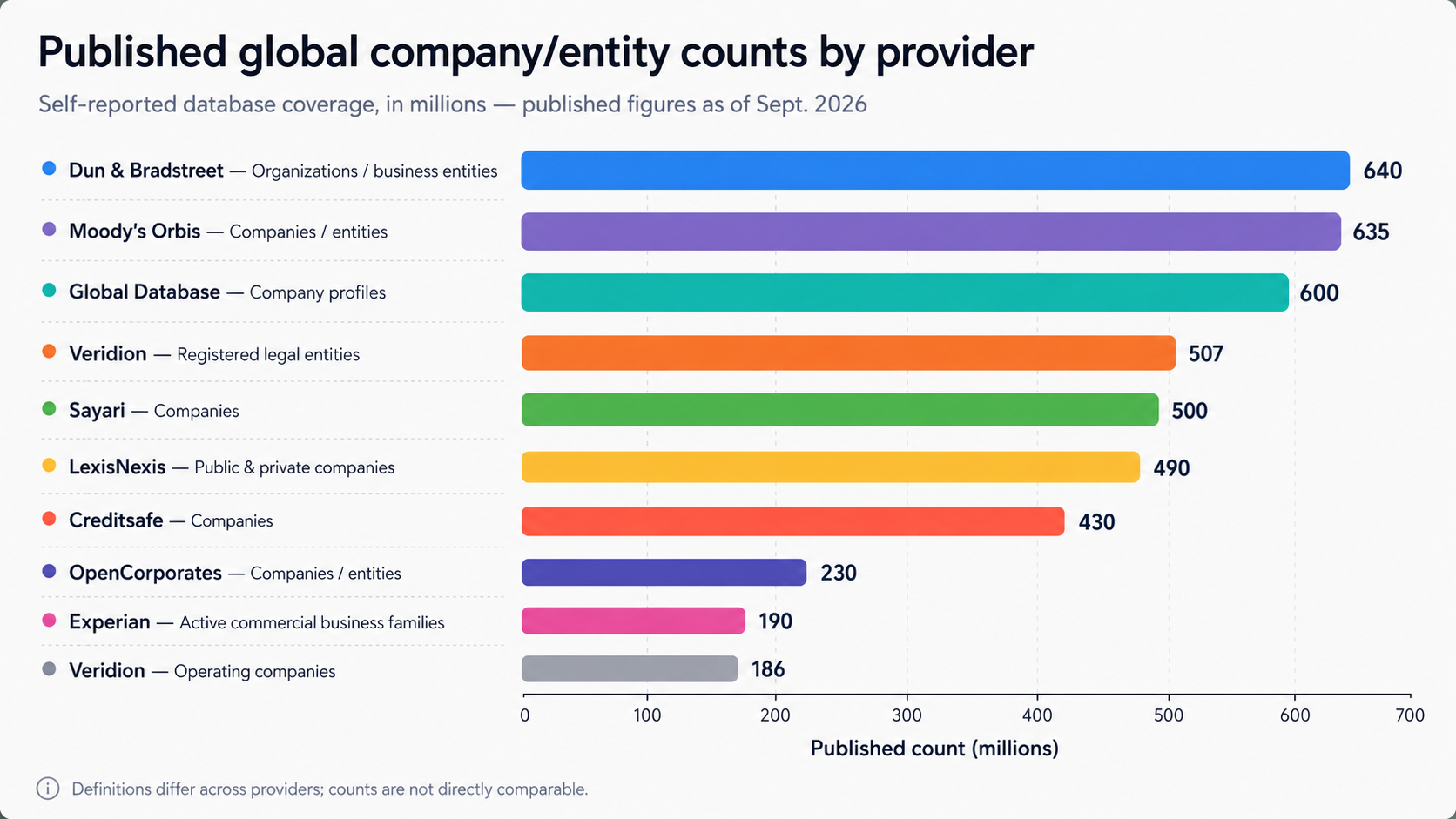
This helps explain why major company databases can report 500 million, 600 million or more records and still have noticeable gaps. Their headline totals may include historical entities, foreign registrations, different entity types, unresolved duplicates or multiple records associated with one underlying company. A large record count does not automatically translate into complete coverage of the companies that currently matter.
The denominator is also moving quickly. China and the United States alone generate millions of new company registrations and business applications each year. Add Europe, India, Latin America, Asia-Pacific, the Middle East and Africa, and a reasonable global estimate is roughly 20 million to 25 million new company identities every year. That is around 55,000 to 70,000 new entities per day.
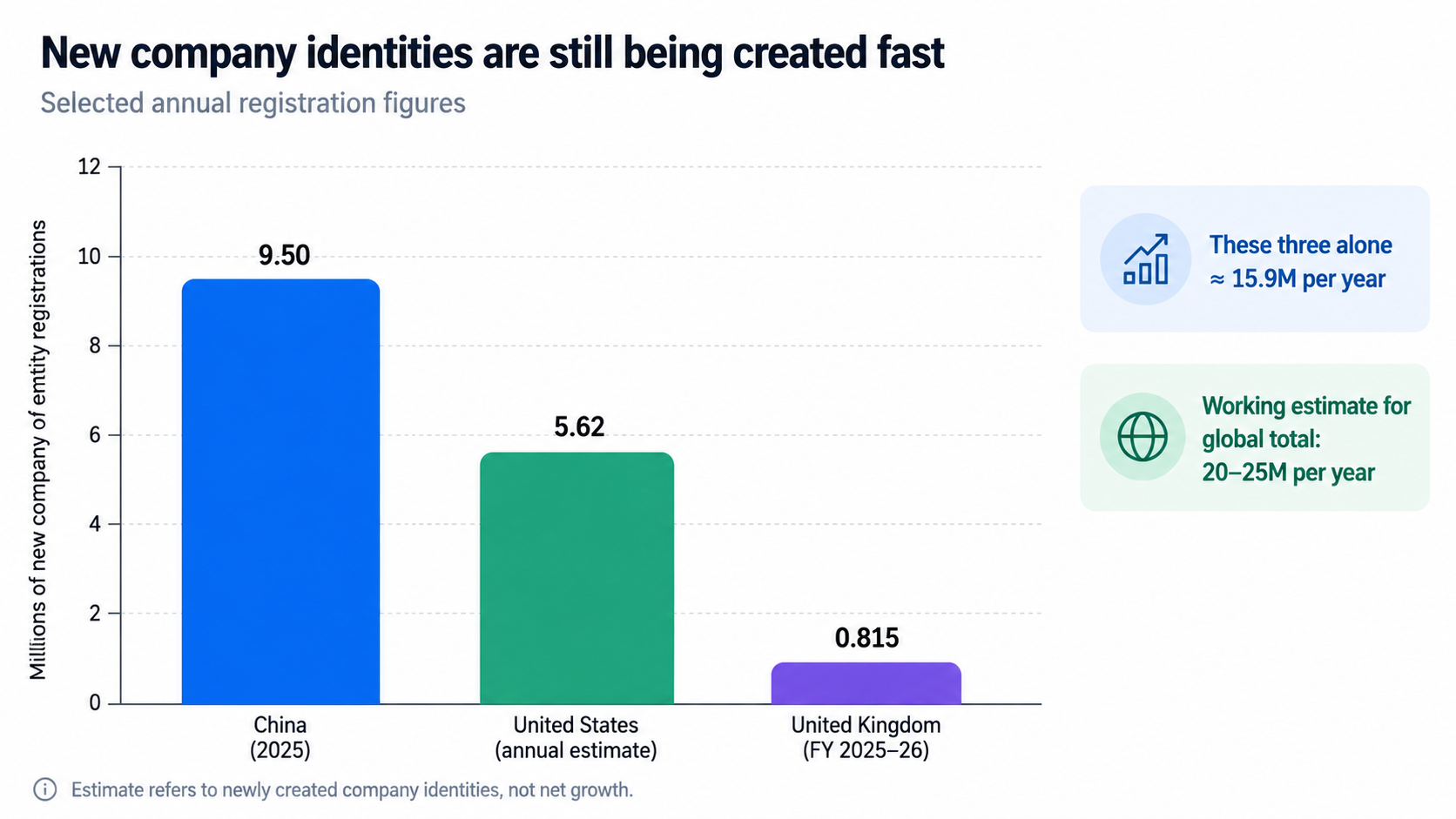
Keeping a global company database current is therefore a continuous ingestion problem. Ownership identification makes it considerably harder.
Company data is not ownership data
A company record may contain a legal name, registration number, address, directors and status without containing any usable ownership information.
Even when ownership information exists, there are several distinct levels of coverage. A database may know the direct shareholder of a company. It may know the ultimate corporate parent. It may be able to trace several layers of subsidiaries and holding companies. None of those necessarily identifies the ultimate beneficial owner.
For compliance purposes, the ultimate beneficial owner is normally a natural person who ultimately owns or controls the company. If the ownership chain ends at another corporation, the job is not finished.
Consider a simple structure:
Operating Company → Holding Company → Regional Holding Company → Family Investment Vehicle → Individual
Finding the first shareholder is useful. Finding the ultimate corporate parent is better. But the UBO question is only answered once the chain reaches the relevant individual or individuals and the ownership or control relationship can be established.
Why ownership coverage is so much harder
The first problem is that the underlying government data is inconsistent and often incomplete. More than 100 countries now have some form of beneficial ownership register, but access, structure and coverage vary widely. Some provide public, machine-readable data; others restrict access, require manual searches, or publish only limited ownership information.
Even where a jurisdiction has strong ownership disclosure, the trail may not end there. A disclosed owner may be another company, which may in turn be owned through several additional entities across different countries. If that chain reaches a jurisdiction with limited disclosure or opaque ownership rules, the trail can break before reaching a natural person.
This is why global UBO coverage remains difficult even when the target company itself sits in a relatively transparent registry. Providers can combine registry data with filings, corporate disclosures and other sources to fill some gaps, but the quality of the final UBO result is ultimately constrained by the weakest point in the ownership chain.
Ownership relationships are not the same as UBO coverage
The large commercial providers do maintain substantial ownership datasets. Some report hundreds of millions of companies with ownership information, while others report billions of ownership relationships. Those figures are useful, but they need to be interpreted carefully.
Moody’s Orbis provides a useful example of the scale difference. It reports 636 million companies and entities and more than 2 billion ownership links, but 193 million of those ownership links are classified as active. These figures measure different things: an ownership link is a relationship between entities or people, not a count of companies for which a complete natural-person UBO can be determined.
An ownership relationship is one edge in a graph. A company with six shareholders may produce six ownership links. A multinational group with hundreds of subsidiaries can produce thousands of parent-subsidiary and shareholder relationships. Historical ownership adds even more.
At the same time, another company may appear perfectly in the database but have no usable ownership information beyond a director or a corporate shareholder.
This means a database can contain billions of ownership links while still having a much smaller number of companies for which the complete ownership chain is known.
The most useful number would be the number of companies for which a provider can identify all relevant natural-person UBOs, trace the path from those people to the target company, provide the ownership percentage or other control basis, and show current source evidence. Public provider materials generally do not report UBO completion rate as a comparable metric.
Ownership data also has a time and source dimension. A company register, shareholder register, UBO register and securities filing can each contain different information about the same company because they were recorded at different times and under different rules. The Beneficial Ownership Data Standard addresses this by representing ownership information as sourced statements about people, companies and relationships at a particular point in time. This allows different sources to be compared, discrepancies to be identified, and changes in ownership to be tracked rather than forcing everything into a single definitive record.
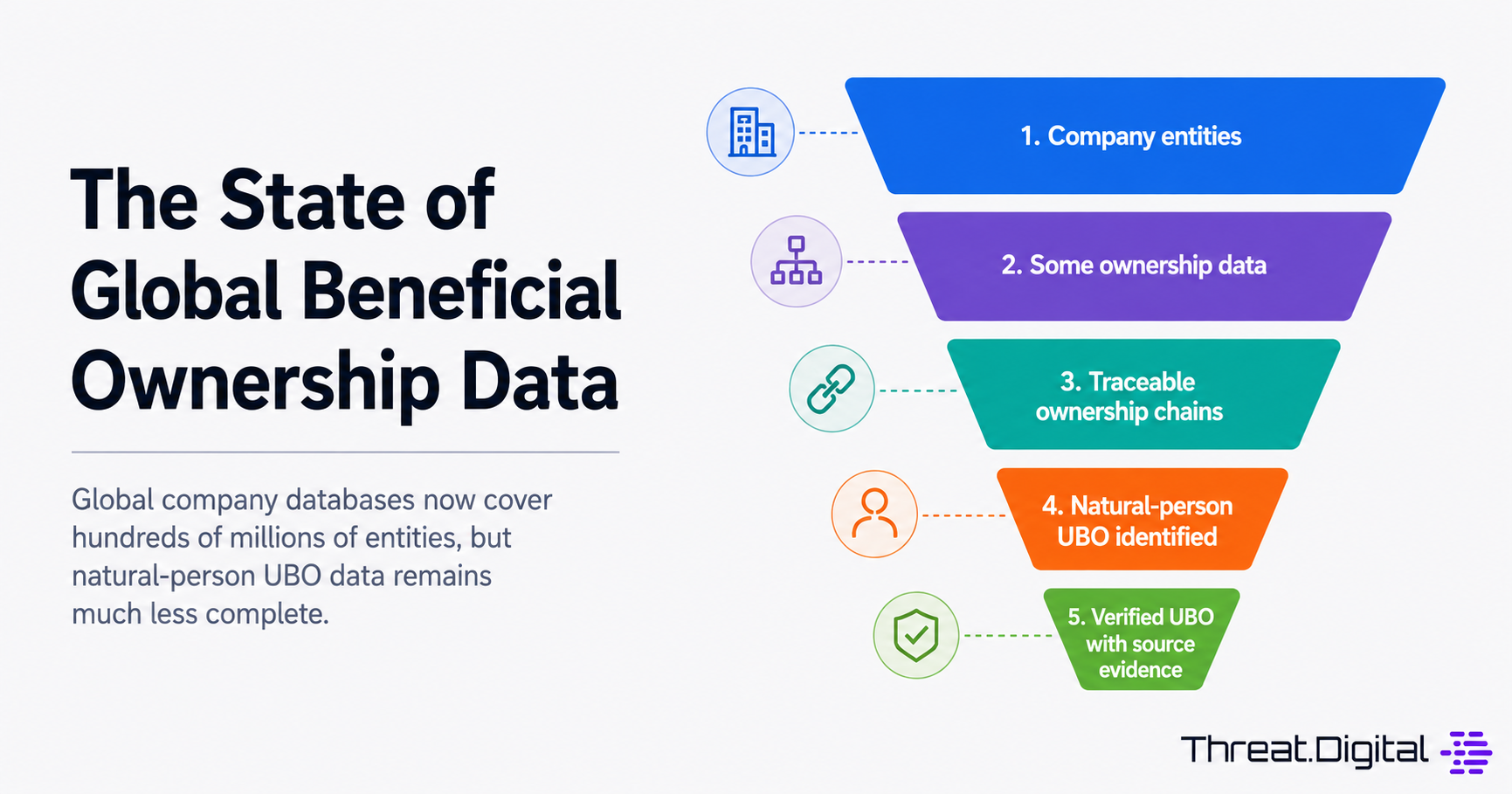
The ownership funnel
A useful way to think about the market is as a funnel.
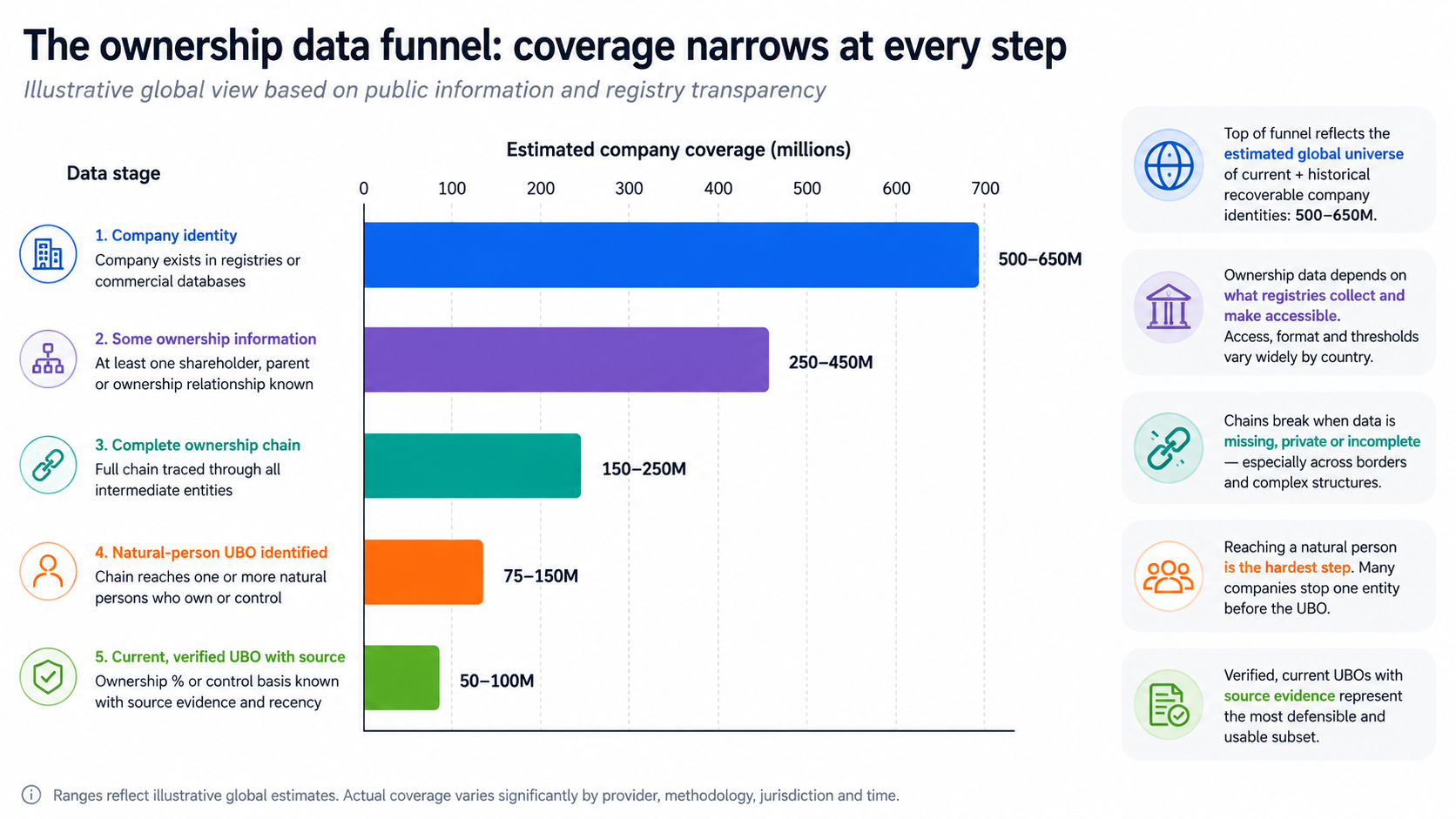
At the top are roughly 200 million to 250 million currently registered companies. A large portion of those can be identified through corporate registries and commercial databases.
The next layer is companies with at least some shareholder or corporate relationship data. That universe is smaller, although still very large.
Below that are companies for which the ownership chain can be followed through every intermediate entity. Coverage falls again whenever the chain crosses a jurisdiction with weak disclosure, private registers, missing percentages or inaccessible records.
At the bottom are companies for which a current, defensible natural-person UBO can be determined.
That is the dataset most compliance users actually want, and it is almost certainly much smaller than the headline company counts suggest.
What buyers should measure instead
The better metric is not database size. It is UBO completion rate.
For a sample of currently registered companies, a useful benchmark would measure whether the provider finds the exact entity, identifies direct shareholders, provides ownership percentages, follows corporate shareholders across jurisdictions, reaches the natural person, calculates indirect ownership correctly, identifies control that is not purely share-based, shows source provenance and keeps the information current.
Unfortunately, there is no reliable way to determine this from provider-reported coverage figures alone. The best approach is to take a representative sample of real companies where you would expect to identify ownership and test each system directly. Every vendor will have different strengths and weaknesses by jurisdiction, entity type and source coverage, and none will be complete. Testing actual cases will give you a much better measure of ownership coverage than relying on headline database sizes or vendor claims.
Where does this all leave us
Global company identity data is available at extraordinary scale. The practical current and historical company universe is probably in the range of 500 million to 650 million identifiable company records, with roughly 200 million to 250 million companies legally registered today.
Beneficial ownership is nowhere near as complete from a data perspective. Anyone telling you otherwise should be treated with a high level of skepticism.
The underlying government data is fragmented, access rules differ by jurisdiction, ownership percentages are often missing, corporate chains cross borders, and many countries do not make authoritative UBO information publicly available at scale. Commercial providers can fill some of those gaps through entity resolution, graph analysis and alternative sources, but they cannot manufacture authoritative ownership information where the source data does not exist.
Beneficial ownership is still a data-quality problem. For compliance teams, the most meaningful test is whether a provider can take a real company and reliably resolve it to the correct natural-person owner with current, traceable evidence.