
The Search Layer Behind Agentic Due Diligence
Search looks simple from the outside. For AML, due diligence, and financial crime research, getting the right information to an agent requires much more work underneath.

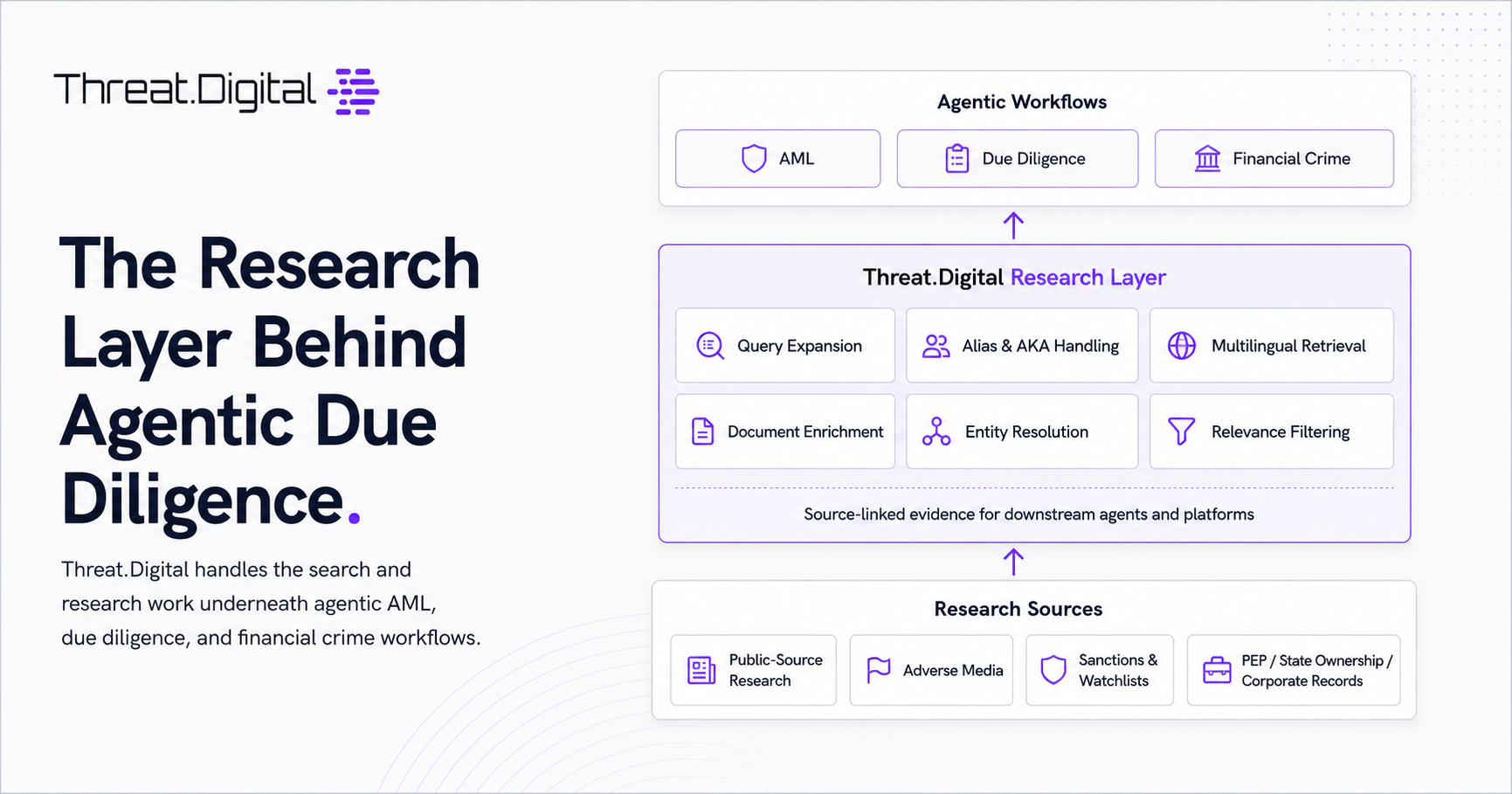
Agentic systems are getting better at deciding what to investigate, which tools to call, and how to use the information they receive. Their output still depends heavily on the information those tools return, which makes search and research infrastructure one of the most important parts of the agentic system.
For due diligence and financial crime research, a good search layer has to find relevant information about the correct person or company across different names, languages, sources, and risk topics. It also has to remove enough irrelevant material that the agent can work with the results efficiently.
Finding the right information is a recall problem
A basic search integration is straightforward: generate a query, retrieve the top results, and give them to a model. This is usually where most AI search systems stop (basically looking at the top 10 Google results).
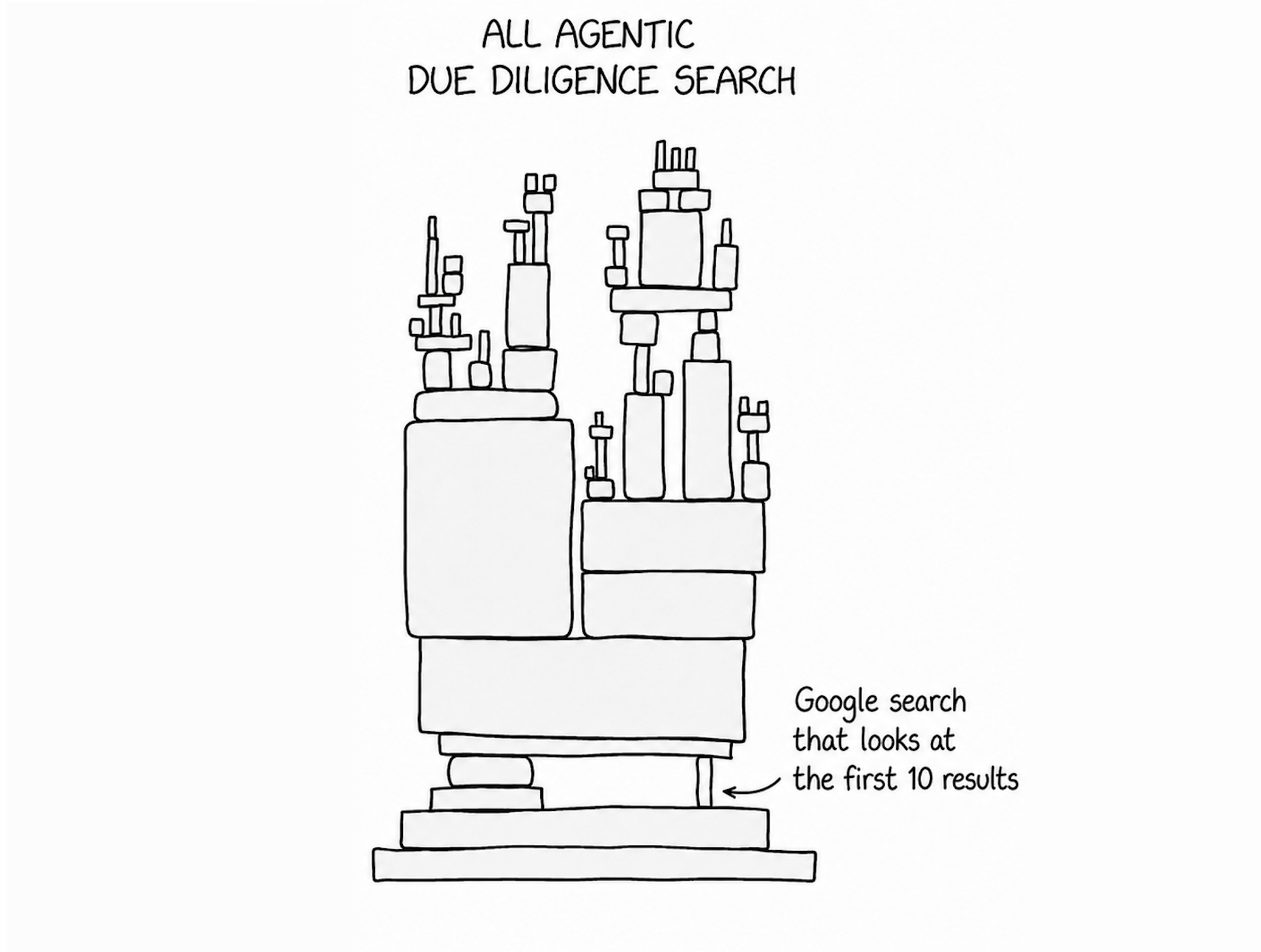
The harder question is whether the important information appeared in those results at all. An agent can produce a well-written, fully cited answer from five good sources and still miss another important source because it was published under a former company name, written in another language, or described the issue using terminology that never appeared in the original query.
Due diligence subjects make this particularly difficult. Companies can have legal names, trade names, abbreviations, former names, local-language names, and subsidiaries, while individuals may appear under different spellings, transliterations, or aliases.
Research therefore usually involves multiple searches around the same subject. Name variations, transliterations, jurisdictions, risk topics, and information discovered during the research can all lead to different queries.
Better recall also creates more noise
Running more searches increases the chance of finding relevant information, but it also produces more unrelated material. The system has to determine which results actually concern the subject and which happen to contain similar names or terminology.
Entity resolution is a major part of that work. An article about fraud involving someone who shares the subject's name may be a valid search result, but associating it with the wrong person would create a false finding.
Location, age, employment, associated organizations, aliases, and relationships can help resolve those cases. Research can also uncover new context, such as a former company name or related entity, that improves later searches and filtering.
This makes research iterative. Information retrieved during one step can change what the system searches for and how it evaluates later results.
Multilingual research requires more than translation
Global due diligence, and especially third-party risk, often depends on information that was never published in English. A company may be known primarily by a local-language name, a person's name may have several valid transliterations, and local reporting may describe the same risk using terminology that differs from an English-language query.
The research layer has to account for those variations while still connecting the results to the correct person or company. It also has to normalize enough of the retrieved information that sources from different languages can be compared and analyzed together.
LLMs are useful in several parts of this process, including alias expansion, multilingual processing, entity extraction, risk classification, and interpretation of source material. Those tasks sit alongside conventional search, retrieval, indexing, and data-processing techniques.
Retrieved documents become structured research data
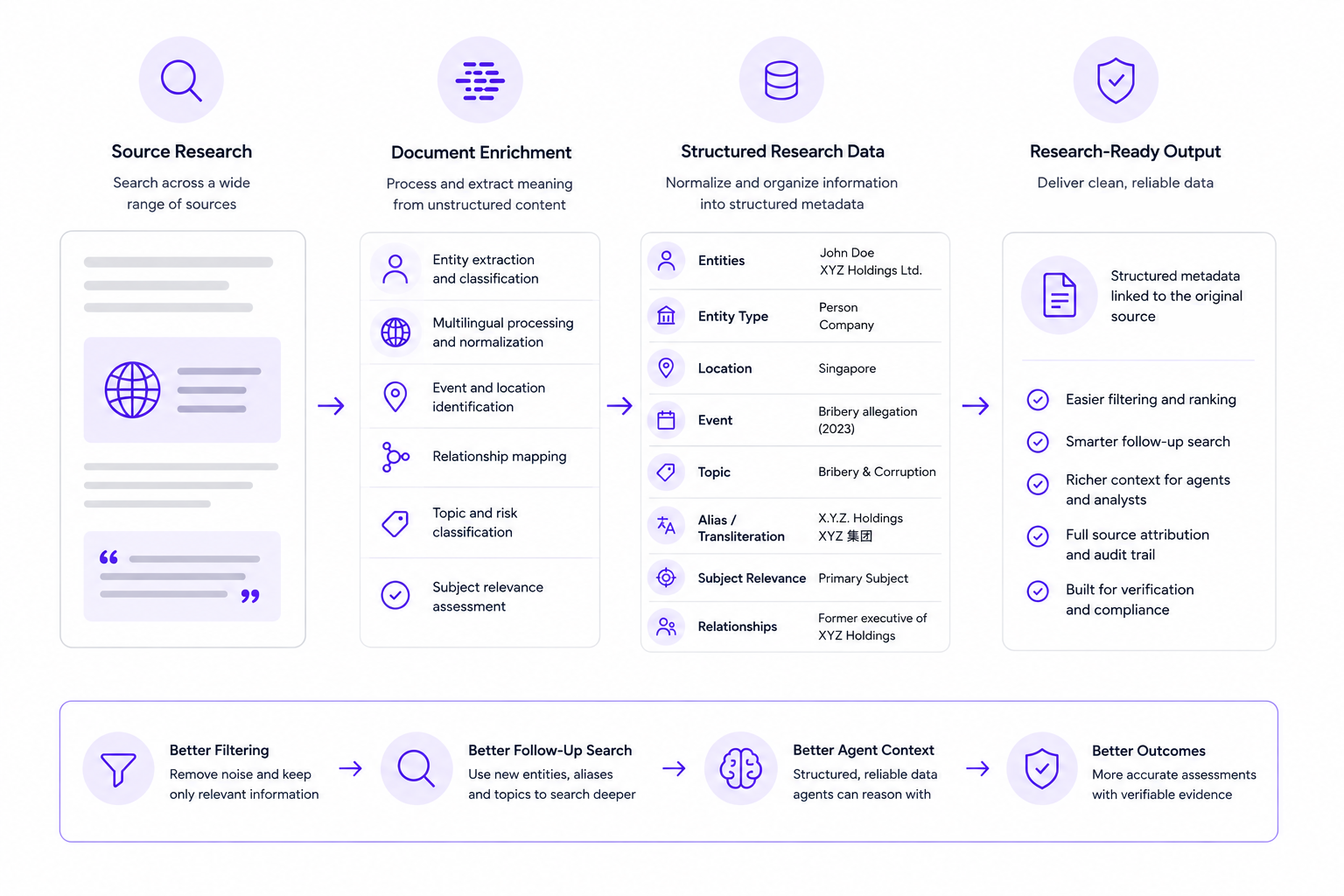
Finding a document is only part of the research process. A source may contain several people, organizations, locations, events, relationships, and risk topics inside a large block of unstructured text.
During ingestion, that material can be enriched with structured metadata. Depending on the source, useful fields can include entities, entity types, locations, aliases, transliterations, events, topics, relationships, and whether a particular person or company is actually central to the event being described.
That structure improves later retrieval and filtering. A system can distinguish the subject of an allegation from a company that was mentioned only in passing, filter results by topic or entity, and use newly identified names or relationships to run additional searches.
It also gives downstream agents cleaner context. Instead of repeatedly interpreting every raw source from the beginning, the agent can work with structured information while retaining the connection to the underlying evidence.
Search infrastructure has to keep changing
Search systems behave differently across names, languages, jurisdictions, publishers, and risk topics. Many of the difficult cases become visible only after the same kinds of research are run repeatedly at meaningful scale.
Threat.Digital currently processes millions of searches per month across due diligence, adverse media, AML, sanctions, political exposure, ownership, third-party risk, and related financial crime research. That volume exposes recurring issues with query construction, transliteration, entity matching, source structure, and retrieval coverage.
Those patterns provide practical feedback for changes to search strategies, models, metadata extraction, filtering, and source handling. The work is continuous because search providers change, websites change, new sources become useful, and model capabilities improve.
The vertical focus also matters. Search behavior learned from financial crime and diligence research is different from behavior learned across a general mix of consumer questions, shopping queries, travel searches, and other unrelated tasks.
Where this fits in an agentic architecture
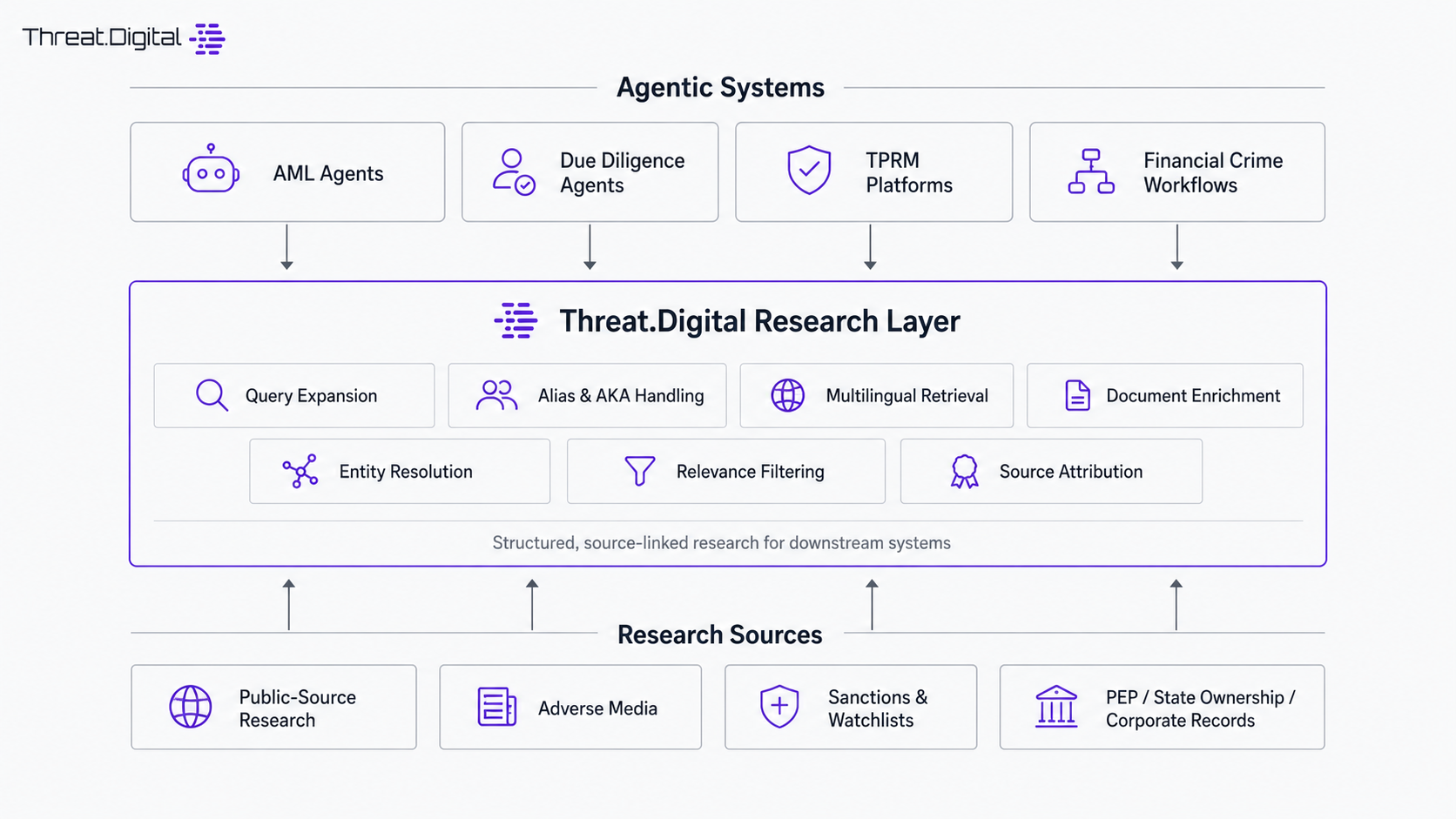
An agentic AML, due diligence, or TPRM system still needs to decide what it wants to investigate and what to do with the result. The underlying research can be handled as a separate service that the agent calls when it needs external information.
DiligenAI exposes that research infrastructure through API. A system can submit a company, individual, or research objective and receive structured, source-linked results without having to maintain its own multilingual retrieval, document enrichment, entity resolution, filtering, and source-handling pipeline. The API can be incorporated into TPRM, AML, KYC, onboarding, investigation, and other risk workflows.
The same architecture also applies after the initial research is complete. Continuous monitoring can keep searching for new information about the subject and deliver relevant developments back into the external system, allowing an agent or workflow to respond when the underlying risk picture changes rather than repeating the entire research process on a fixed schedule.
For teams building agentic compliance systems, that creates a fairly clean division of responsibilities. The agent can focus on orchestration, reasoning, workflow, and decisions, while the research layer handles the retrieval and evidence infrastructure that has to remain accurate, broad, and current.